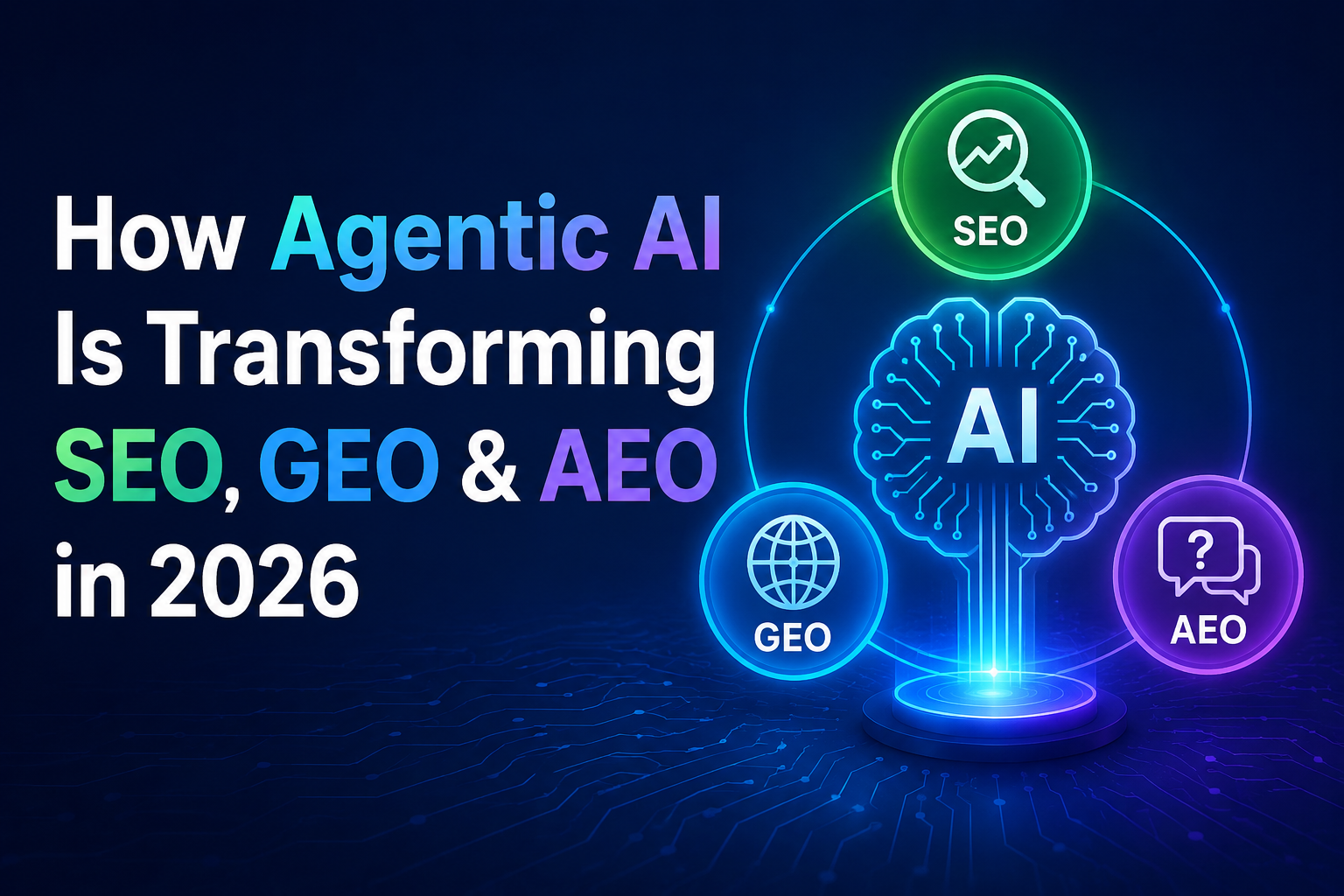
Search is no longer just about ranking on Google. In 2026, brands are optimizing for three overlapping disciplines: traditional SEO, Generative Engine Optimization (GEO), and Answer Engine Optimization (AEO). And the force accelerating all three is agentic AI — autonomous AI systems that don't just generate content or suggestions, but actively plan, execute, and refine optimization strategies with minimal human input.
For businesses in India and beyond, understanding this shift isn't optional anymore. AI agents are already crawling, summarizing, and recommending brands inside ChatGPT, Google AI Overviews, Perplexity, and voice assistants. If your content strategy hasn't adapted, you're invisible in the exact places your customers are now searching.
What Is Agentic AI, and Why Does It Matter for Search?
Agentic AI refers to AI systems capable of pursuing a goal, making decisions, and taking multi-step actions with limited supervision — as opposed to generative AI, which primarily produces content on request. In search and marketing terms, an AI agent doesn't just draft a blog post when asked. It can research a topic, identify content gaps, structure the page for both human readers and AI crawlers, publish it, monitor performance, and adjust the strategy — all with minimal manual oversight.
This matters because SEO, GEO, and AEO all involve dozens of ongoing micro-decisions: which keywords to target, how to structure content for featured snippets, how to format answers for AI Overviews, and how to keep technical SEO healthy. Agentic AI can now handle much of this continuously, rather than through periodic manual audits.
SEO in the Age of Agentic AI
Traditional SEO hasn't disappeared — it has evolved. Agentic AI systems are increasingly used to:
- Continuously audit technical SEO issues (site speed, crawl errors, broken links) and queue fixes automatically.
- Analyze search intent shifts in real time and adjust keyword targeting before rankings drop.
- Generate and update internal linking structures based on topical authority gaps.
- Run and interpret A/B tests on meta titles and descriptions without waiting for a monthly review cycle.
The result is SEO that behaves less like a quarterly project and more like a live, self-correcting system — provided a human strategist is still guiding brand voice, quality standards, and business priorities.
GEO: Optimizing for Generative AI Engines
Generative Engine Optimization is the practice of making content easily understood, trusted, and cited by AI systems like Google's AI Overviews, ChatGPT, Perplexity, and Copilot. Unlike classic SEO, GEO isn't about ranking a blue link — it's about being the source an AI model chooses to summarize or cite when answering a user's question.
Agentic AI plays a growing role here by simulating how large language models parse and rank content. Agents can test how a page is likely to be summarized by an AI engine, then restructure it — clarifying definitions, adding structured data, and tightening factual claims — to improve the odds of citation. Some agentic tools even monitor brand mentions across AI chat platforms and alert teams when competitors are being cited instead.
AEO: Winning the Answer, Not Just the Click
Answer Engine Optimization focuses on structuring content so it can be lifted directly into voice assistants, featured snippets, and zero-click search results. As more queries end without a click-through, brands need content formatted as direct, extractable answers — clear headers, concise definitions, and well-organized lists.
Agentic AI supports AEO by scanning top-performing answer formats across a niche, then restructuring existing content to match those patterns — rewriting a paragraph into a scannable definition, or converting a process into a numbered list an assistant can read aloud. This kind of continuous reformatting used to require manual content audits; now it can run in the background as an ongoing agentic workflow.
Why SEO, GEO, and AEO Now Work as One System
The old approach of treating SEO, GEO, and AEO as separate strategies is becoming inefficient. A single well-structured, authoritative page can rank organically, get cited by an AI Overview, and get read aloud by a voice assistant — if it's built correctly from the start. Agentic AI is what makes managing all three simultaneously realistic, because it can evaluate the same page against multiple optimization criteria at once and suggest a unified set of edits, instead of forcing marketing teams to run three disconnected audits.
The Human Role Doesn't Disappear — It Shifts
None of this means marketers become obsolete. Agentic AI systems still require clear goals, brand guardrails, and quality checks. A human strategist decides what the business should be known for, approves tone and factual accuracy, and interprets ambiguous market signals that data alone can't explain. The agencies and teams that win in 2026 are the ones that use agentic AI to remove repetitive execution work, while keeping strategic judgment firmly in human hands.
Getting Started with Agentic SEO, GEO, and AEO
Businesses looking to adapt don't need to overhaul everything overnight. A practical starting point looks like this:
- Audit existing top content for how easily it can be extracted, summarized, or cited by AI engines.
- Identify 5–10 priority pages to restructure for both search engines and AI answer engines.
- Introduce agentic tools for ongoing technical SEO monitoring rather than one-off audits.
- Track brand visibility inside AI chat platforms, not just traditional search rankings.
- Keep a human editor in the loop for accuracy, tone, and brand consistency.
Final Thoughts
2026 marks the point where SEO, GEO, and AEO stop being three separate checklists and start becoming one continuous, AI-managed discipline. Agentic AI is the engine behind that shift — handling the repetitive, data-heavy work of optimization so that human marketers can focus on strategy, creativity, and trust-building. Brands that adapt early will be the ones AI engines choose to recommend, cite, and read aloud — while those that don't risk becoming invisible in the very places their customers are now searching.