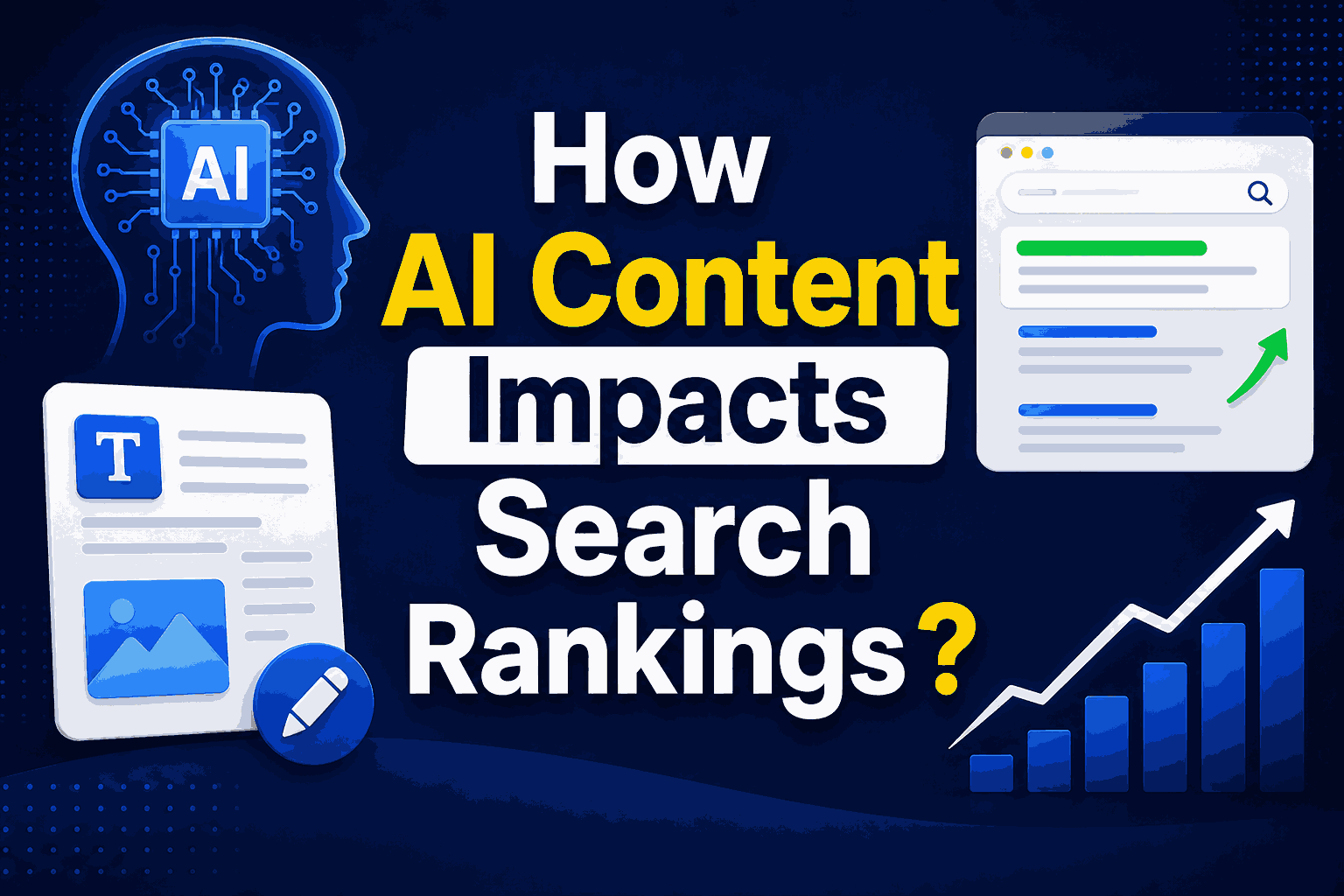
Artificial intelligence has fundamentally changed how content gets created. Tools that once took hours to draft a blog post can now produce a full article in minutes, and businesses of every size have rushed to take advantage of this speed. But this shift has raised an urgent question for marketers and website owners alike: does AI-generated content help or hurt search rankings? The answer is more nuanced than a simple yes or no, and understanding it is critical for anyone building a long-term SEO strategy.
What Google Actually Says About AI Content
Contrary to popular belief, Google has been clear that it does not penalize content simply because it was produced by AI. Its guidance has consistently focused on quality rather than the method of production. Google's stated approach rewards content that demonstrates real experience, expertise, authoritativeness, and trustworthiness, often referred to as E-E-A-T, regardless of whether a human or a machine typed the words. In other words, the tool used to create content matters far less than whether that content is genuinely useful to the person reading it.
Where AI Content Runs Into Trouble
While AI itself isn't penalized, the way many businesses use it often is. Search engines have become increasingly sophisticated at identifying low-effort, mass-produced content designed purely to manipulate rankings. Pages filled with generic, repetitive, or shallow AI text, especially when published at scale without human review, tend to underperform or even get filtered out of search results entirely. This pattern, sometimes called content spam, has led to real ranking drops for websites that treated AI as a shortcut to publish hundreds of pages overnight with little regard for depth or accuracy.
Quality Signals Still Matter Most
Search rankings are shaped by a wide range of signals: originality, depth of coverage, accuracy, user engagement, backlinks, and how well content matches search intent. AI-generated drafts often struggle with these signals when left unedited, since they can produce generic phrasing, factual errors, or content that sounds plausible but lacks real insight. Search engines are designed to reward content that reflects genuine expertise and firsthand knowledge, something raw AI output frequently lacks unless it's grounded in accurate research and refined by a knowledgeable editor.
The Rise of AI Content Detection and Its Limits
Many site owners worry about AI content detection tools flagging their pages. In reality, search engines do not rely on simple AI detectors to determine rankings, largely because such detectors are unreliable and can misclassify well-written human content as AI-generated, and vice versa. Instead, ranking systems evaluate outcomes: does the content satisfy the searcher's query, does it get read and shared, does it earn links, and does it hold up against competing pages. This outcome-based approach is far more resistant to gaming than a binary AI-or-human classification could ever be.
How AI Content Can Actually Help Rankings
When used thoughtfully, AI can strengthen an SEO strategy rather than undermine it. AI tools are excellent at accelerating research, generating outlines, identifying content gaps, and drafting initial versions that a human editor then refines with expertise, examples, and a distinct point of view. This human-AI collaboration can increase publishing efficiency while maintaining the quality bar search engines expect. Many successful publishers now use AI as a first-draft assistant rather than a final-output generator, keeping a human firmly in the loop for accuracy, tone, and strategic judgment.
Practical Ways to Use AI Content Without Hurting SEO
- Always have a human editor review, fact-check, and add original insight before publishing.
- Avoid publishing large volumes of AI content in a short period without quality control.
- Add original data, case studies, or firsthand experience that AI cannot generate on its own.
- Focus on genuinely answering search intent rather than just hitting keyword targets.
- Monitor performance metrics like engagement and rankings to catch quality issues early.
The Bigger Picture: Helpfulness Over Origin
As AI tools become further embedded in everyday content workflows, the distinction between human-written and AI-assisted content will likely matter less than it does today. What will continue to matter is whether content is genuinely helpful, accurate, and trustworthy. Search engines are optimizing for user satisfaction, not for policing which tool produced a paragraph. Businesses that treat AI as a productivity multiplier, layered with human expertise and editorial oversight, are best positioned to benefit from both efficiency and strong rankings.
Conclusion
AI content does not inherently harm search rankings, but careless, low-quality use of it certainly can. The real determinant of ranking success remains the same as it has always been: does the content genuinely help the person searching for it? By combining the speed of AI with the judgment, expertise, and originality of human editors, businesses can scale their content output without sacrificing the quality signals that search engines, and readers, ultimately reward.