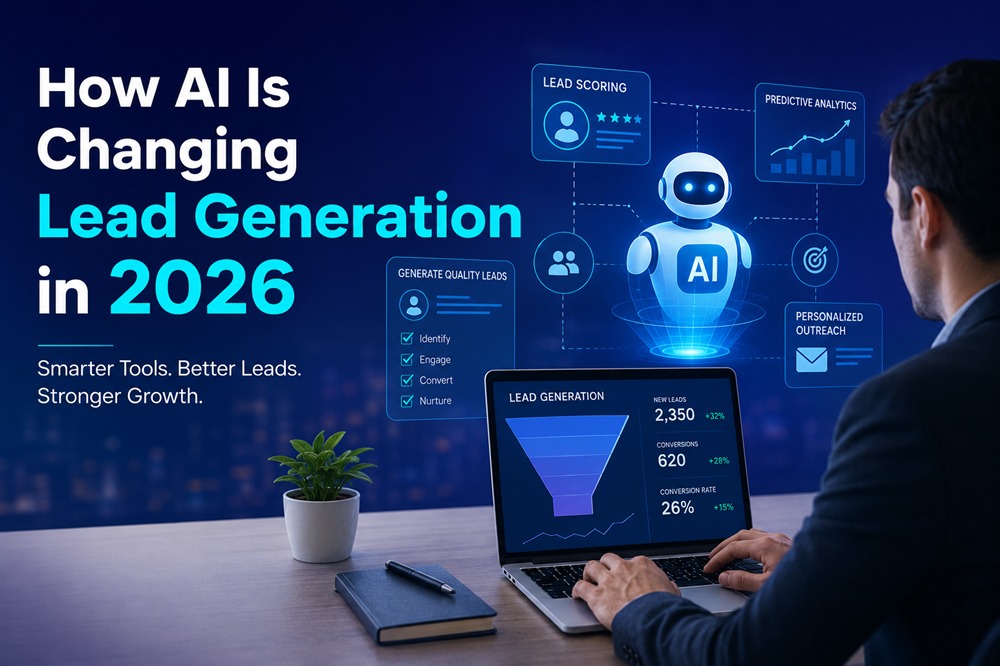
Lead generation has always been about one thing: getting the right message in front of the right person at the right time. What's changed in 2026 is how that happens. Artificial intelligence is no longer a “nice-to-have” layered on top of marketing campaigns — it's becoming the engine that decides who gets targeted, what they see, and when they're nurtured toward a sale.
For Indian businesses competing in increasingly crowded digital markets, understanding these shifts isn't optional anymore. Here's what's actually changing, and what it means for how you generate leads going forward.
1. Predictive Lead Scoring Has Replaced Guesswork
Traditional lead scoring relied on static rules — a form fill was worth 10 points, an email open was worth 2. AI-driven scoring models now analyze hundreds of behavioral signals in real time: browsing patterns, time spent on pricing pages, email engagement history, and even firmographic data for B2B leads.
The result is a much more accurate picture of purchase intent. Sales teams stop wasting time on leads that look promising on paper but were never going to convert, and instead focus on the prospects an AI model flags as genuinely sales-ready.
2. Conversational AI Is Capturing Leads 24/7
AI chatbots and voice assistants have matured far beyond scripted FAQ bots. In 2026, conversational AI can qualify a visitor, answer product-specific questions, book a consultation, and hand off a fully qualified lead to a sales rep — all without human involvement, at any hour.
This matters most for industries with long research cycles, like real estate, healthcare, and B2B SaaS, where a prospect browsing at 11 PM might otherwise be lost by morning.
3. Hyper-Personalization at Scale
Personalization used to mean inserting a first name into an email subject line. AI now enables dynamic personalization across entire customer journeys — different landing page layouts, different ad creative, and different offers shown to different visitor segments, generated and tested automatically rather than manually.
- Dynamic landing pages: content and CTAs adapt based on the visitor's source, location, and browsing history.
- AI-generated ad variations: platforms like Google's Performance Max test dozens of creative combinations to find what resonates with each audience segment.
- Behavior-triggered email sequences: nurture emails adjust content and timing based on how a lead actually engages, not a fixed drip schedule.
4. Smarter, More Efficient Ad Spend
AI-powered bidding and budget allocation have made paid acquisition significantly more efficient. Instead of manually adjusting bids across campaigns, machine learning models now shift spend toward the audiences, keywords, and placements most likely to convert — often reallocating budget within hours based on real-time performance data.
For PPC campaigns specifically, this means lower cost-per-acquisition and less wasted spend on low-intent clicks, since automated bidding strategies are continuously learning from every conversion event.
5. Content and Outreach at a Different Speed
AI tools are now used to draft first versions of nurture emails, ad copy variations, and even personalized outreach messages for sales teams — dramatically cutting the time between identifying a lead and reaching out to them. The businesses winning with this aren't replacing human judgment; they're using AI to handle the first draft so their teams can focus on strategy and relationship-building.
6. The Privacy and First-Party Data Shift
As third-party cookies phase out and privacy regulations tighten, AI models are increasingly trained on first-party data — information businesses collect directly through their own websites, CRMs, and forms. This makes owning a clean, well-structured data pipeline more valuable than ever.
Businesses that invest in proper CRM integration and lead tracking now will have a meaningful advantage as AI models become even more dependent on high-quality first-party signals.
What This Means for Your Business
AI hasn't replaced the fundamentals of lead generation — attracting the right audience, building trust, and guiding prospects toward a decision. What it's changed is the speed and precision with which that happens. Businesses that combine AI-powered tools with a coordinated SEO, PPC, and CRO strategy are seeing shorter sales cycles, lower acquisition costs, and higher-quality leads reaching their sales teams.
The businesses falling behind aren't the ones without AI tools — they're the ones using AI in isolated pieces without a strategy tying it all together.
Building an AI-Ready Lead Generation Funnel
A few practical starting points for 2026:
- Audit your CRM and tracking setup to ensure clean first-party data is being captured at every stage.
- Use predictive lead scoring to prioritize sales follow-up instead of treating every lead equally.
- Test AI-driven bidding on at least one PPC campaign before rolling it out account-wide.
- Add a conversational AI layer to capture and qualify leads outside business hours.
- Keep human oversight on messaging and strategy — AI accelerates execution, it doesn't replace judgment.
Final Thoughts
AI is changing how leads are found, scored, and nurtured — but the businesses seeing real results are the ones treating it as part of an integrated funnel, not a standalone tool. If you're looking to build an AI-supported lead generation system tailored to your industry, Conceptial Media's lead generation services combine SEO, PPC, and CRO into one coordinated strategy designed to keep pace with where marketing is heading.
Ready to see what an AI-ready lead generation funnel could look like for your business? Request a free proposal and get a custom strategy built around your goals.