Introduction
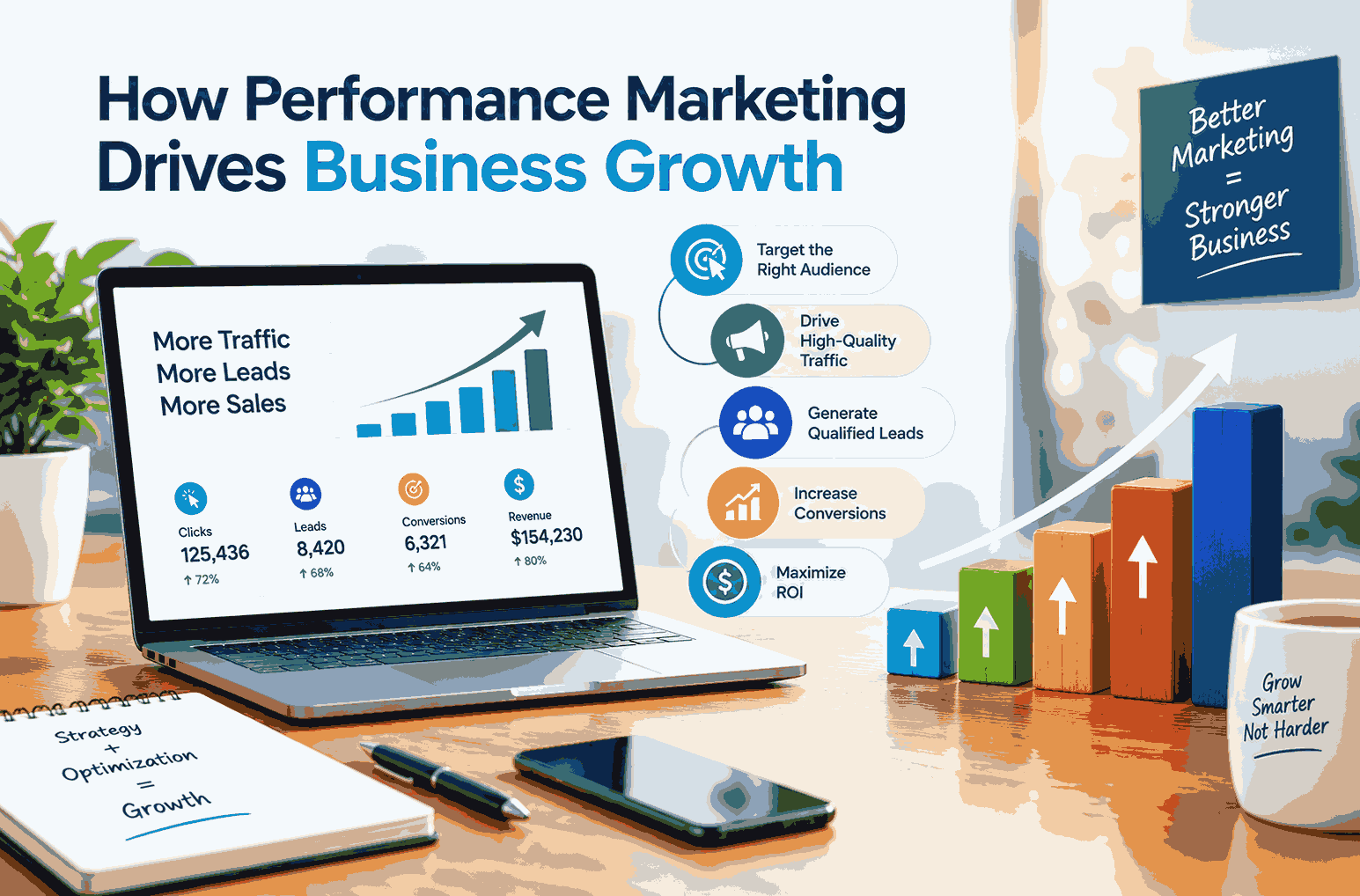
Every business wants marketing that delivers results it can see, measure, and repeat. Traditional advertising often leaves owners guessing which rupee, dollar, or euro actually brought in a customer. Performance marketing changes that. Instead of paying for exposure and hoping for the best, you pay for specific outcomes such as clicks, leads, sign-ups, or sales.
In this post, we'll look at what performance marketing is, why it works, and how it drives sustainable business growth.
What Is Performance Marketing?
Performance marketing is a results-based approach to digital advertising in which brands pay only when a defined action is completed. That action might be a click, a form submission, an app install, a purchase, or a phone call.
Common pricing models include:
- CPC (Cost Per Click): you pay each time someone clicks your ad.
- CPL (Cost Per Lead): you pay for every qualified lead generated.
- CPA (Cost Per Acquisition): you pay when a customer completes a purchase or sign-up.
- CPI (Cost Per Install): you pay for each app installation.
Because spending is tied directly to outcomes, every campaign can be tracked, compared, and improved.
1. Measurable Results and Clear ROI
The biggest advantage of performance marketing is transparency. With analytics tools, conversion tracking, and attribution models, you can see exactly which ads, keywords, and audiences generate revenue.
This clarity lets you calculate return on ad spend (ROAS) and customer acquisition cost (CAC) with confidence. When leadership asks, "What did marketing deliver this quarter?", you have real numbers rather than vague impressions.
2. Lower Risk and Better Budget Control
Traditional campaigns such as print, billboards, or TV require large upfront commitments with uncertain returns. Performance marketing lets you start small, test ideas, and scale only what works.
You can set daily budgets, pause underperforming ads instantly, and shift spend toward top-performing channels. This flexibility makes it especially valuable for startups and growing businesses that need every marketing dollar to count.
3. Precise Audience Targeting
Platforms like Google Ads, Meta, LinkedIn, and YouTube allow targeting based on:
- Demographics such as age, gender, and location
- Interests and online behavior
- Search intent and keywords
- Past website visits (retargeting)
- Lookalike audiences modeled on your best customers
Reaching the right people at the right moment reduces wasted spend and raises conversion rates. Someone searching "buy running shoes online" is far more valuable than a random viewer, and performance marketing lets you prioritize that intent.
4. Faster Growth Through Continuous Optimization
Performance marketing thrives on testing. Marketers run A/B tests on headlines, creatives, landing pages, calls to action, and audience segments. Small improvements compound quickly. A landing page that lifts conversions from 2% to 3% means 50% more customers from the same traffic.
This cycle of launch, measure, learn, and optimize lets brands scale faster and more predictably than with campaigns that run on instinct alone.
5. Full-Funnel Impact
Strong performance marketing doesn't stop at the click. It supports every stage of the customer journey:
- Awareness: video, social, and display ads introduce your brand to new audiences.
- Consideration: search ads, content, and retargeting keep you in front of interested prospects.
- Conversion: optimized landing pages and clear offers turn visitors into buyers.
- Retention: email, remarketing, and loyalty campaigns bring customers back for repeat purchases.
When the entire funnel is optimized, growth becomes more efficient and lifetime customer value increases.
Key Performance Marketing Channels
Search Engine Marketing (SEM): captures high-intent users actively searching for your products or services.
Social Media Advertising: builds demand and drives conversions through highly targeted campaigns.
Affiliate Marketing: partners earn commissions for sales they generate, so you pay only for results.
Influencer Partnerships: trackable codes and links tie creator content to real conversions.
Email and Marketing Automation: nurtures leads and boosts repeat purchases at a low cost.
Programmatic and Display Advertising: extends reach and powers retargeting across the web.
Metrics That Matter
To drive growth, track the numbers that connect to revenue:
- ROAS (Return on Ad Spend): revenue earned per unit of ad spend
- CAC (Customer Acquisition Cost): total cost to win one customer
- Conversion Rate: percentage of visitors who complete the desired action
- CTR (Click-Through Rate): how compelling your ads are
- LTV (Lifetime Value): total revenue a customer brings over time
A healthy business keeps LTV comfortably higher than CAC. Watching this ratio helps you decide how aggressively to scale.
Best Practices for Success
- Set clear goals. Define what a conversion means for your business before launching.
- Install proper tracking. Use pixels, tags, and analytics to capture every key action.
- Invest in landing pages. Even great ads fail if the page doesn't convert.
- Test relentlessly. Experiment with creatives, copy, offers, and audiences.
- Use first-party data. Build email lists and customer segments you own.
- Balance short- and long-term goals. Combine performance campaigns with brand-building for lasting growth.
- Review reports regularly. Weekly check-ins catch problems early and reveal scaling opportunities.
Common Mistakes to Avoid
- Chasing clicks instead of qualified conversions
- Ignoring mobile experience and page speed
- Scaling budgets before proving profitability
- Relying on a single channel
- Neglecting retention, which is often cheaper than acquisition
Conclusion
Performance marketing drives business growth because it connects spending directly to results. With measurable ROI, flexible budgets, precise targeting, and continuous optimization, it gives businesses of every size a reliable way to attract customers and scale profitably.
If you want marketing that proves its value, start by defining your goals, tracking the right metrics, and testing consistently. Over time, the insights you gather will become one of your strongest competitive advantages.
Ready to grow with performance marketing? Audit your current campaigns, identify your best-performing channel, and scale it step by step.