Introduction
Every organization today is racing to become more digital — but digital transformation is not just about adopting new tools. It is about rethinking how people, processes, and data connect. At the center of this shift sits one often-underestimated asset: the custom portal. Whether it serves customers, employees, vendors, or partners, a well-designed portal acts as the digital front door to a business, shaping how stakeholders experience, interact with, and derive value from an organization's systems.
Off-the-shelf software can only take a business so far. As companies scale and their workflows grow more complex, generic platforms start to feel like a compromise rather than a solution. This is where custom portals step in, offering a tailored, unified experience that generic tools simply cannot replicate.
What Is a Custom Portal?
A custom portal is a purpose-built digital gateway designed around the specific needs of an organization and its users. Unlike generic dashboards or third-party software, a custom portal is built from the ground up to reflect unique workflows, branding, security requirements, and integrations. Examples include customer self-service portals, employee intranets, supplier management systems, and partner collaboration hubs.
Because these portals are designed specifically for the business that uses them, they can evolve alongside the organization rather than forcing the organization to adapt to a rigid, one-size-fits-all product.
Why Custom Portals Matter for Digital Transformation
1. Centralized Access to Information
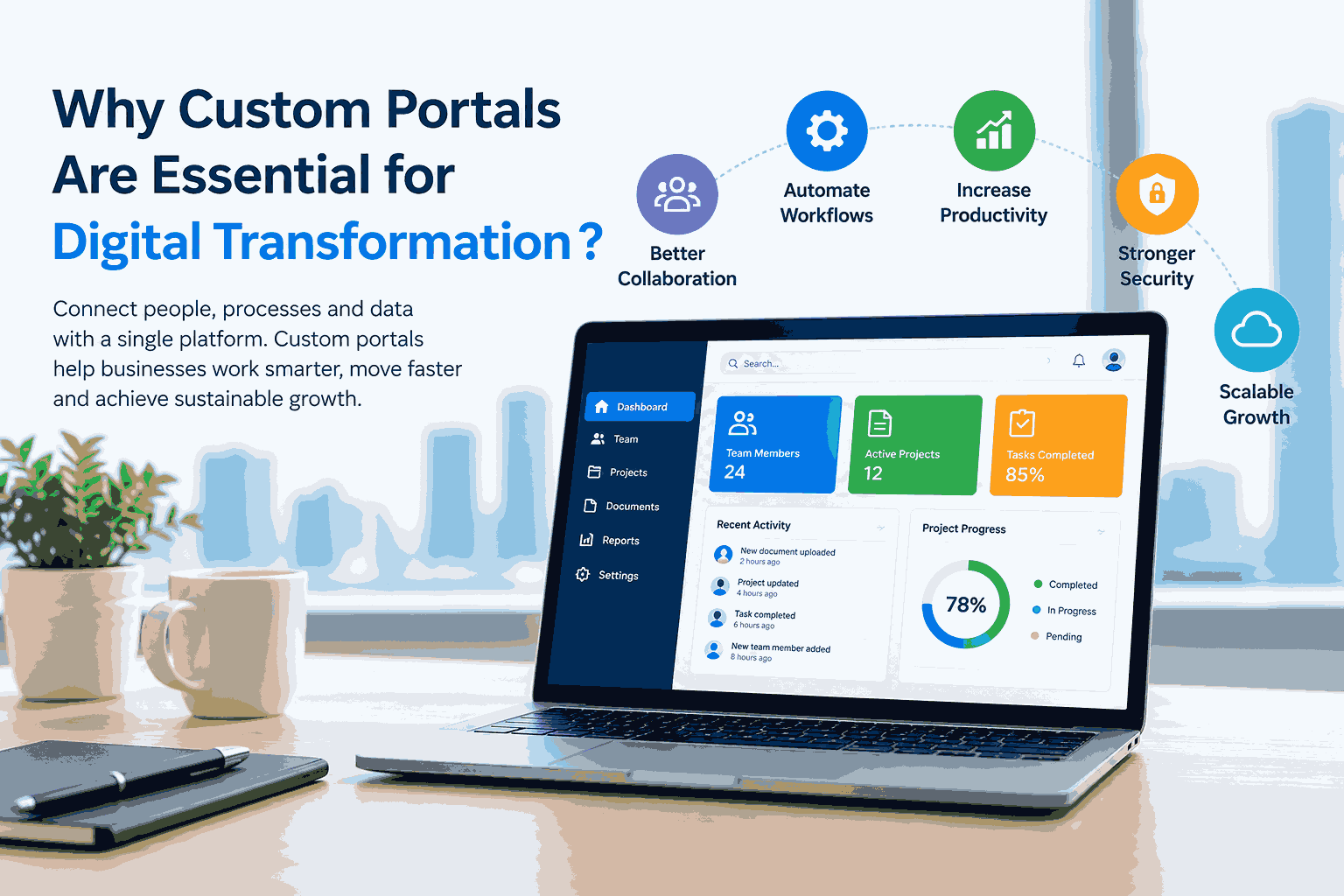
Digital transformation often fails not because of a lack of technology, but because of fragmented systems. Employees and customers are forced to juggle multiple logins, disconnected tools, and inconsistent data. A custom portal consolidates these touchpoints into a single, coherent interface, giving users centralized access to the information and services they need — reducing friction and boosting productivity.
2. Personalized User Experience
Generic platforms treat every user the same way. Custom portals, by contrast, can be tailored to different roles, permissions, and preferences. A sales representative might see performance dashboards, while a customer sees order tracking and support resources. This level of personalization increases engagement and makes digital tools feel genuinely useful rather than generic.
3. Seamless Integration with Existing Systems
Most organizations rely on a mix of legacy systems, CRMs, ERPs, and third-party applications. A custom portal can be engineered to integrate directly with these systems through APIs, creating a unified layer that pulls data from multiple sources without forcing a costly rip-and-replace of existing infrastructure. This makes transformation incremental and far less disruptive.
4. Improved Operational Efficiency
Manual processes — spreadsheets, email chains, paper forms — are the enemies of digital transformation. Custom portals automate repetitive workflows such as approvals, reporting, and data entry, freeing employees to focus on higher-value work. Over time, this automation compounds into significant cost and time savings.
5. Stronger Security and Compliance
Off-the-shelf platforms come with generic security models that may not align with an organization's regulatory obligations. Custom portals allow businesses to build security, authentication, and compliance controls directly into the architecture — whether that means role-based access control, data encryption, or industry-specific compliance such as HIPAA or GDPR.
6. Scalability for Future Growth
As a business grows, its digital needs change. A custom portal is built with scalability in mind, so new features, user groups, or integrations can be added without overhauling the entire system. This flexibility is critical for organizations that view digital transformation as an ongoing journey rather than a one-time project.
7. Better Customer and Employee Experience
Ultimately, digital transformation is about people. Custom portals improve satisfaction on both sides of the business — customers get faster, more relevant service, while employees get tools that actually fit how they work. This translates directly into loyalty, retention, and stronger brand perception.
Real-World Applications of Custom Portals
- Customer Portals – self-service dashboards for order tracking, billing, and support tickets
- Employee Portals – centralized intranets for HR requests, documents, and internal communication
- Vendor and Supplier Portals – streamlined procurement, invoicing, and compliance tracking
- Partner Portals – collaborative spaces for co-selling, training, and resource sharing
- Healthcare Portals – secure patient record access and appointment management
Key Considerations Before Building a Custom Portal
Organizations considering a custom portal should evaluate a few critical factors before starting development:
- Clearly define the target users and their specific needs
- Map out existing systems that will need to integrate with the portal
- Establish security and compliance requirements early in the design process
- Choose a technology stack that supports long-term scalability
- Plan for ongoing maintenance, updates, and user feedback loops
Conclusion
Digital transformation is not a destination — it's an evolving process of aligning technology with the way people actually work and interact with a business. Custom portals sit at the heart of this evolution, providing the centralized, secure, and personalized experience that generic software cannot match. For organizations serious about transformation, investing in a custom portal isn't just a technical upgrade — it's a strategic move toward long-term agility, efficiency, and growth.
Businesses that embrace custom portals today are better positioned to adapt to tomorrow's challenges, making them not just a nice-to-have, but an essential pillar of digital transformation.