Every business owner has heard the old marketing joke: "Half my advertising budget is wasted; I just don't know which half." For decades, broad-reach advertising made that joke feel unavoidable. Today, it doesn't have to be. Performance marketing has changed the rules by tying every rupee, dollar, or euro you spend to a measurable outcome.
In this article, we'll look at what separates the two approaches and why performance marketing is the smarter choice for most growing brands.
What Is Broad-Reach Advertising?
Broad-reach advertising aims to put your message in front of as many people as possible. Think television commercials, billboards, radio spots, print ads, and mass-market sponsorships. You pay for exposure, typically based on impressions or airtime, and hope the right people notice.
It has real value for building brand awareness at scale. But it comes with a major limitation: you pay for eyeballs, not results. You rarely know who saw the ad, who acted on it, or whether it led to a sale.
What Is Performance Marketing?
Performance marketing is a results-driven approach where you pay only when a specific action happens, such as a click, a lead, a sign-up, an app install, or a purchase. Channels include search ads, social media ads, affiliate marketing, native advertising, and retargeting campaigns.
Instead of buying attention, you buy outcomes. That single shift makes everything more accountable.
1. You Pay for Results, Not Just Exposure
With broad-reach campaigns, budgets are committed upfront regardless of performance. If the campaign flops, the money is gone. Performance marketing flips that model. Whether you pay per click (CPC), per lead (CPL), or per acquisition (CPA), your spend is linked directly to actions that matter to your business. This reduces financial risk, especially for startups and small businesses with limited budgets.
2. Precise Targeting Reduces Waste
A billboard is seen by everyone who drives past it, including people who will never buy from you. Performance marketing lets you narrow your audience using:
- Demographics: age, gender, location, and language.
- Interests and behavior: what people browse, search, and engage with.
- Intent signals: people actively searching for your product or service.
- Custom audiences: past visitors, email subscribers, and lookalike audiences of your best customers.
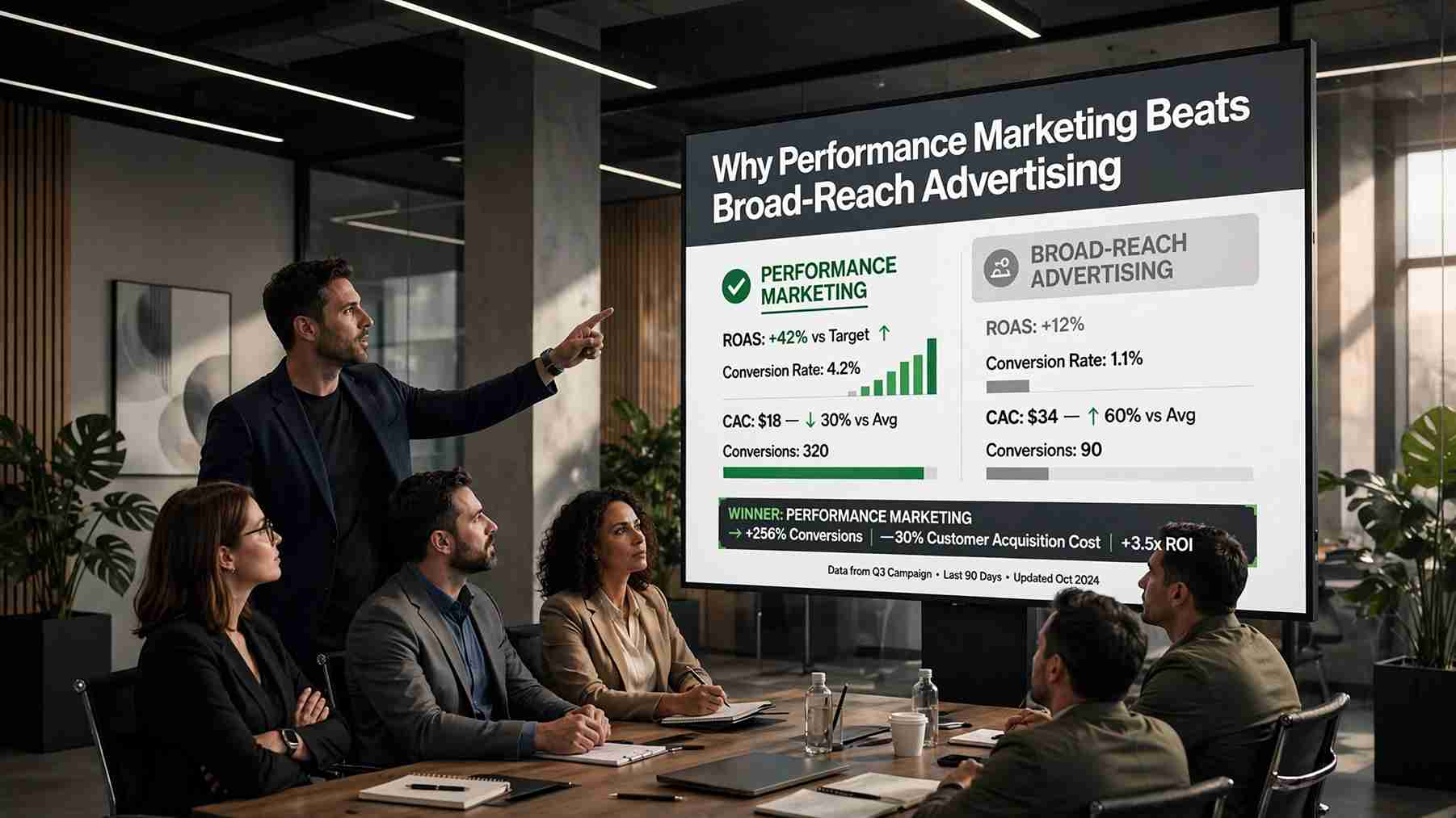
When your ads reach people who are already likely to buy, your conversion rates rise and your cost per customer falls.
3. Everything Is Measurable
Performance marketing gives you a clear view of what's working. You can track impressions, click-through rate, cost per acquisition, conversion rate, customer lifetime value, and return on ad spend (ROAS) in real time. Analytics tools show you the complete customer journey, from first click to final purchase.
Broad-reach advertising, by contrast, depends heavily on estimates, surveys, and assumptions. Attribution is fuzzy, making it hard to prove that a campaign actually drove revenue.
4. Faster Optimization and Flexibility
A TV commercial can take weeks to plan and produce, and once it airs, you can't change it. With performance marketing, you can launch a campaign in hours and improve it continuously. If an ad headline underperforms, swap it. If one audience converts better, shift more budget there. A/B testing lets you refine creatives, offers, landing pages, and bidding strategies based on real data instead of guesswork.
This agility means your campaigns get better over time, and your cost per result usually goes down as you learn.
5. Better ROI and Easier Scalability
Because you can identify your most profitable channels and campaigns, you can double down on winners and cut losers quickly. Once you know that spending X on a campaign brings back 4X in revenue, scaling becomes a confident decision rather than a gamble. Broad-reach advertising scales in cost far faster than it scales in provable returns.
6. Accessible for Businesses of Every Size
National television campaigns and prime-location billboards demand large budgets. Performance marketing lets a small business start with a modest daily spend and grow as results come in. This levels the playing field, allowing smaller brands to compete with established players on relevance and creativity rather than budget alone.
7. Deeper Customer Insights
Every click, form fill, and purchase generates data. Over time, you learn which messages resonate, which products attract which audiences, and what drives repeat purchases. These insights improve not only your ads but also your product, pricing, and overall business strategy. Broad-reach campaigns rarely offer this level of feedback.
Does Broad-Reach Advertising Still Have a Place?
To be fair, broad-reach advertising isn't useless. Large brands with big budgets use it to build recognition and emotional connection over the long term. The strongest strategies often combine both: broad-reach for awareness, performance marketing for conversion.
But if your goal is measurable growth, whether that means more leads, sales, or app downloads, performance marketing should be the foundation of your strategy. It lets you prove value, protect your budget, and grow with confidence.
Tips to Get Started with Performance Marketing
- Set clear goals: define what a "conversion" means, such as a sale, a lead, or a sign-up.
- Install proper tracking: use analytics, conversion pixels, and UTM parameters from day one.
- Start small and test: run multiple ad variations and learn before scaling.
- Optimize your landing pages: great ads need fast, clear pages that convert.
- Review and refine regularly: track ROAS and CPA weekly and adjust budgets accordingly.
Final Thoughts
Marketing budgets are investments, and every investment should be accountable. Performance marketing offers what broad-reach advertising cannot: transparent spending, precise targeting, real-time optimization, and clear proof of return. In a competitive digital landscape where every rupee counts, paying for results is simply smarter than paying for hope.
Ready to turn your ad spend into measurable growth? Start with one performance campaign, track the results, and let the data guide your next move.